

 Back to Blog
Rolling out HubSpot's Prospecting Agent to a B2B sales team is mostly an enablement project, not a configuration project. Getting reps to trust an AI that drafts their first emails takes training, a period where every draft is reviewed by a person, and a roadmap that adds capability in phases. That is how we introduced it at Eternity Group Mexico, an international freight forwarder, which piloted the agent with its sales team in a live B2B environment in late 2025.
Short answer
To roll out the Prospecting Agent well, you need four things: a team that understands what the agent does and does not do, a configuration built on your real selling context, a pilot in review mode where a person approves every email, and a named owner for that review. Eternity Group Mexico's pilot started with the first three: training, configuration and review mode.

Eternity Group Mexico's website.
Who Eternity Group Mexico is
Eternity Group Mexico is an international freight forwarder specializing in maritime, air and ground transportation. It runs global operations with a strong presence on Asia to Latin America trade lanes, and provides end-to-end logistics for importers and exporters who need reliability, visibility and service built around their shipments.
Before this pilot, we had already worked with Eternity on HubSpot Marketing Hub services. The pilot was the next step in its digital transformation: finding out whether AI could make its commercial team faster at prospecting without making its outreach worse.
What the Prospecting Agent is today
When Eternity piloted it, HubSpot called it the Breeze Prospecting Agent. HubSpot has since moved its agents into Agent Hub, and the product page now lists it simply as the Prospecting Agent. The Breeze name lives on in Breeze Assistant, HubSpot's AI assistant.
In HubSpot's description, it does three jobs:
- It monitors buying signals and scores accounts against your ideal customer profile.
- It sources contacts across the buying committee from data providers such as ZoomInfo and Apollo.
- It drafts emails in each rep's voice, personalized by account and grounded in company signals.
Two things to check before a pilot, both from HubSpot's setup guide as of September 2026. Setting up and using the agent takes a Super Admin, or a user with prospecting agent access permissions. Sourcing new contacts from an external provider means connecting your own account with that provider, and only one provider can be connected at a time.
It works in review mode, where a rep approves each AI-drafted email before it is sent, or in automatic mode, which sends without that review. HubSpot lists it on its Starter, Professional and Enterprise editions, and it runs on HubSpot Credits, which are consumed as the agent generates outreach for each lead. As of September 2026, HubSpot lists the price as $1 for each lead the agent recommends outreach for. To size a pilot, estimate how many leads the agent will recommend outreach for each month and multiply by that rate. At 200 leads a month, that is about $200 a month, on top of your subscription and implementation costs. Some subscriptions include monthly HubSpot Credits that can cover part of that usage, so check your plan before you budget.
The starting point: three problems, only one of them technical
Before the pilot, Eternity's sales team faced three prospecting challenges:
- Research was slow. Every new outreach meant manual digging across several sources before a rep could write a single line.
- Personalization was inconsistent. The tone and depth of messages depended on how busy the rep was that week.
- AI was unfamiliar. The team had little experience with AI prospecting tools, so any rollout needed hands-on enablement and change management.
The agent is built to fix the first two. The third decides whether it gets used at all: a team that does not trust the tool either ignores it or approves everything unread. Neither is a pilot.
What we actually did
Our job was to move the team from curiosity to confident use, in four parts:
- A live training session for the whole sales team, covering how AI agents work, responsible use, and real prospecting examples.
- A custom presentation, "Introduction to the Breeze Prospecting Agent," built around Eternity's own sales workflows rather than a generic demo.
- Access to HubSpot's official learning resources, including video tutorials, HubSpot's central page for its AI tools, and the Knowledge Base, so reps had somewhere to go after the session.
- Initial configuration of the agent in semi-autonomous mode, so every draft was reviewed by a person during the pilot and stayed aligned with Eternity's brand.
Below are the setup screens as they looked at the time of the pilot, shown with demo values rather than Eternity's settings.
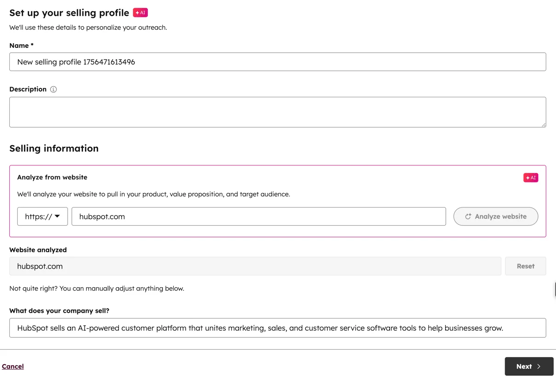
The selling profile tells the agent what you sell and to whom. Rewrite the website-generated draft by hand.
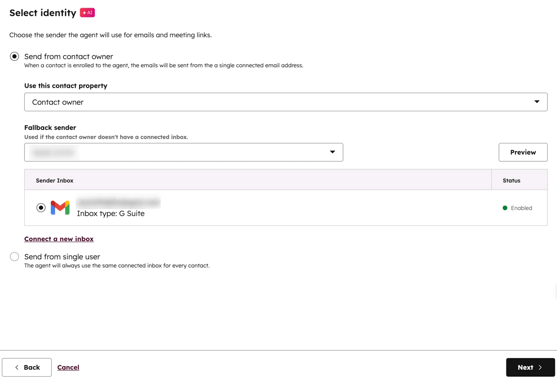
Sending from the contact owner keeps replies with the rep who owns the relationship.
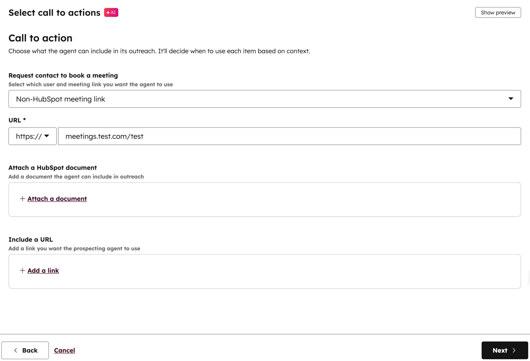
Calls to action set what the agent may offer a prospect, such as a meeting link or a document.
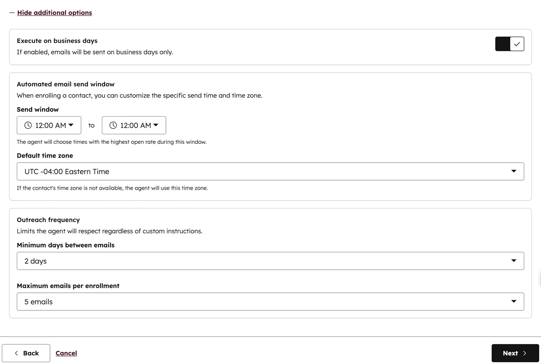
Guardrails matter most in a pilot: send window, minimum gap between emails and a cap per contact.
Why review mode came first
Review mode came first for three reasons.
First, tone. Eternity's outreach is written in Spanish, and a draft that is fluent but slightly off-brand can do more damage than no email at all. Second, evidence. Reps who review drafts learn where the agent is strong and where it needs better inputs before it sends on its own. Third, ownership. Review mode makes someone responsible for what goes out. Automatic sending should be a decision made later, on evidence, by the person who owned that review.
What changed during the pilot
In the first phase, in late 2025, Eternity's sales team ran its initial live tests with the agent. Structurally, the first stage of outreach changed hands during the pilot: the agent did the research and the first draft, and the rep did the judgment. The reps' early feedback was qualitative and positive. They valued three things: the research the agent automates, the quality of its outreach drafts in Spanish, and the fact that it works inside the HubSpot Sales Hub workspace they already use.
If you run a pilot like this, track both kinds of evidence from the start. Rep feedback surfaces usability and training problems early. Usage and outcome measures, such as drafts approved, drafts edited, replies and meetings booked, need a baseline to compare against, and they should be read alongside adoption: early numbers from a team still learning the tool say as much about the rollout as about the agent.
The roadmap: one capability at a time
The Prospecting Agent was the first phase of a wider HubSpot AI roadmap with Eternity, not the whole of it. The planned next phases included:
- Buyer Intent, part of what HubSpot launched as Breeze Intelligence, to identify companies showing interest through their interactions with the website.
- Deal scores, which use AI to predict how likely each open deal is to close, so reps can focus on the opportunities most likely to win. HubSpot lists deal scores on Sales Hub and Smart CRM, Professional and Enterprise.
- Breeze Assistant, formerly Breeze Copilot, to help reps prepare for meetings and follow up after calls.
Each phase is a natural checkpoint to review data privacy and brand consistency before you expand.
Who this suits, and when it is the wrong first step
An AI prospecting agent is a good fit when you already do outbound prospecting, your reps spend real time researching accounts before they write, and your CRM holds enough company and contact data for the agent to work from.
It is the wrong first step when:
- Your CRM data is weak. The agent researches from what you have, so incomplete or duplicated records can produce confident emails built on wrong facts. Fix the data first.
- Nobody owns the review. If no named person is responsible for reading drafts and tuning the agent, review mode becomes a formality and automatic mode becomes a risk.
- You cannot say who you sell to. The selling profile needs a clear product, value proposition and ideal customer. If your team would each describe these differently, settle that before you automate it.
Still weighing up the platform? See what a HubSpot implementation costs. For another enablement project, see the DHL LATAM HubSpot bootcamps, and for more logistics work on HubSpot, see how we built customer-facing freight calculators for Freightzy.
Frequently asked questions
What does HubSpot's Prospecting Agent do?
HubSpot describes it as an agent that monitors buying signals, scores accounts against your ideal customer profile, and drafts outreach emails in each rep's voice, personalized by account. It can run in a review mode, where a rep approves every email before it is sent, or send automatically. It runs on HubSpot Credits. It was launched under the Breeze name and now sits in HubSpot's Agent Hub.
Is the Breeze Prospecting Agent the same as HubSpot's Prospecting Agent?
Yes. The product was launched as the Breeze Prospecting Agent, which is what it was called when Eternity Group Mexico piloted it. HubSpot now lists it as the Prospecting Agent inside Agent Hub, its home for all AI agents. Breeze remains the name of Breeze Assistant, the AI assistant included with HubSpot subscriptions.
Should a sales team start in review mode or fully autonomous?
Start in review mode. Eternity's pilot ran what was then called semi-autonomous mode, so every AI draft passed a person before it reached a prospect. That protects brand tone and gives the team evidence to judge the agent on. Switching to automatic sending should be a decision made on that evidence, not a default.
What do you need in place before rolling out an AI prospecting agent?
Three things: CRM data clean enough for the agent to research from, a clear description of what you sell and to whom, and a named person who owns the review of the agent's drafts. Without those, you risk outreach that is faster but not better, with nobody positioned to catch the difference.
How long before an AI prospecting pilot shows results?
It depends on your outreach volume and sales cycle, so no honest partner can promise a date. What can be planned is the order: enable the team, set a baseline, run live tests in review mode while collecting rep feedback and usage data, then judge response rates and meetings once usage is consistent enough to be meaningful.
Thinking about AI prospecting for your sales team?
We're a HubSpot Elite Partner. We'll help you decide whether an agent is the right next step, and if it is, roll it out so your team actually uses it. See our HubSpot AI sales agent services.
Book a call