
/Flags/us.svg)
/Flags/mx.svg)
/Vector%20(6).svg) Back to Blog
Back to Blog
Digifianz, a HubSpot Elite Partner, designed and ran the DHL LATAM Bootcamp — an inbound training programme for exporters across 17 Latin American countries — entirely inside HubSpot. The outcome: monthly form submissions climbed from roughly 150–200 to over 2,000, and individual webinars drew 2,000–7,000 registrations each.
Key Takeaway
DHL Express didn't need ten disconnected tools — it needed one system and a partner that would answer for the results. Digifianz consolidated the entire bootcamp (website, ads, email, webinars, CRM, reporting) into a single HubSpot portal, turning a live events programme into a always-on lead engine across 17 LATAM markets.
17
LATAM countries
reached from one HubSpot portal
2,000+
form submissions / month
up from roughly 150–200
689,547
emails sent
20.67% average open rate
25,000+
contacts in HubSpot CRM
segmented by lifecycle stage
Source: Digifianz DHL LATAM Bootcamp programme reporting (HubSpot), 2020–2022 campaign.
Who is DHL, and what was the real challenge?
DHL is the world's leading logistics brand — more than 380,000 employees across 220+ countries. But this project wasn't about moving parcels. DHL Express wanted to create demand: to educate small and medium exporters across Latin America, help them take their products to the world, and turn that goodwill into qualified leads for DHL.
DHL's Argentina Head of Marketing, María José Ricaurte, had the idea for a training programme — the DHL Bootcamp — but no inbound engine to run it. The programme launched in Argentina in 2020 and, within a year, expanded to 16 more countries: Bolivia, Chile, Colombia, Costa Rica, Ecuador, El Salvador, Guatemala, Honduras, Nicaragua, Panama, Paraguay, Peru, the Dominican Republic, Uruguay and Venezuela. Seventeen markets, one team, and dozens of moving parts: landing pages, emails, webinars, podcasts, ads, videos and social — all at once.
Here's the trap most companies fall into: they buy a separate tool for each of those jobs, then spend more time stitching tools together than talking to customers. DHL wanted the opposite — one place to build, measure and optimise everything, and one partner accountable for making it work.
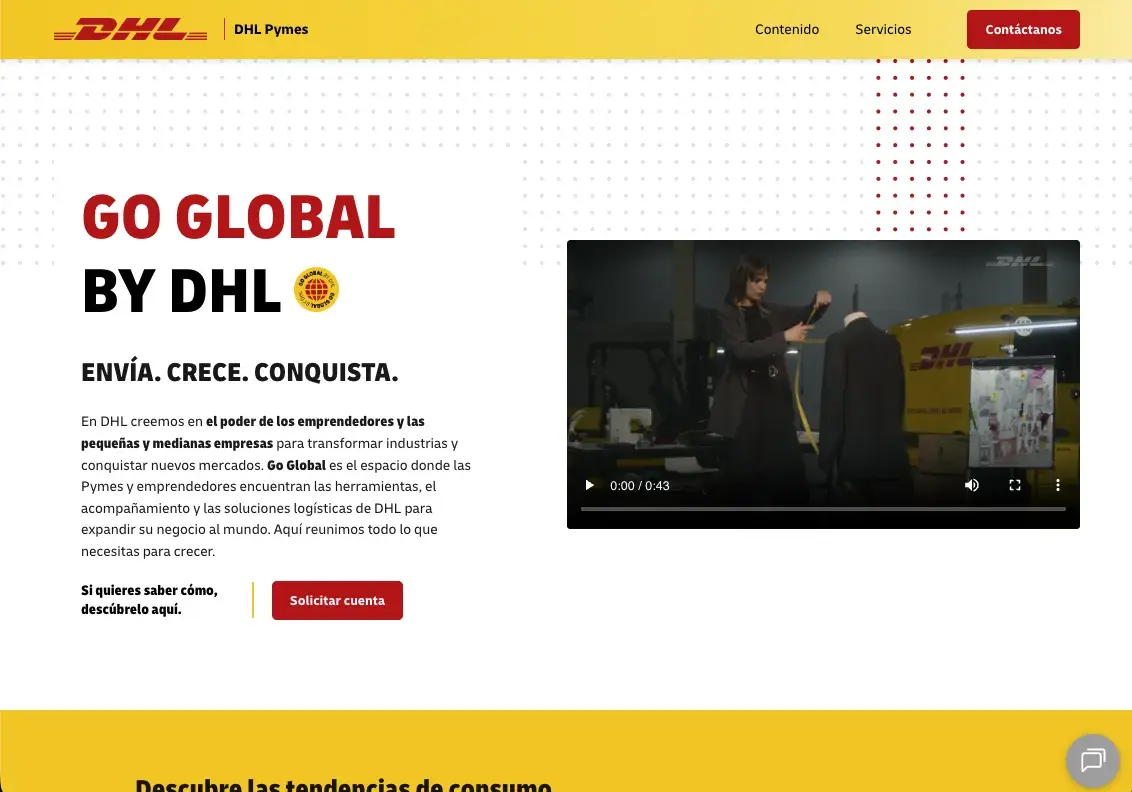
The DHL Pymes programme as it runs today — current screenshot, 2026.
How did Digifianz turn one HubSpot portal into a lead engine?

A traditional agency would have split this brief across freelancers and platforms, billed by the hour, and handed DHL a stack of logins to manage. Digifianz took the opposite approach: we joined DHL's team, ran the programme end-to-end, and treated its results as our own.
The strategic decision that made everything else possible was consolidation. Instead of one tool for the website, another for email, another for ads and another for reporting, Digifianz built the entire bootcamp on a single HubSpot portal. The microsite lived on HubSpot CMS, forms fed straight into the CRM, workflows routed leads to sales, and every campaign reported into the same dashboards. One source of truth, minute by minute, for a programme running in 17 countries at once.
That's the difference between "doing marketing tasks" and building an engine. Because the data was unified, we could see which topics filled webinars, which emails drove registrations and which segments turned into real sales conversations — then optimise, month after month.
What did Digifianz build inside HubSpot?
The DHL Bootcamp wasn't a single campaign — it was a full inbound ecosystem, built and run across HubSpot's Hubs. Here is what that looked like in practice:
A HubSpot CMS microsite
25+ landing pages, 55 SEO-optimised articles, a chatbot and smart content — a permanent home for the bootcamps, panels and podcasts that keeps generating leads long after each live event.
Email & automation at scale
689,547 emails sent at a 20.67% open rate, powered by 100+ behaviour-based workflows — webinar confirmations, follow-ups, nurture tracks and a newsletter keeping DHL top of mind.
A CRM built for sales
25,000+ contacts classified by lifecycle stage, with automated lead assignment and hand-off, so high-intent registrants reached DHL's sales executives instead of getting lost.
Live events + paid amplification
20 webinars produced end-to-end, promoted with weekly campaigns on Google, Meta, YouTube and LinkedIn, plus 800+ social posts and audiovisual content produced for 16 countries.
Sitting on an underused HubSpot portal? A focused HubSpot implementation and onboarding turns it into a lead engine like DHL's.
Book a HubSpot diagnosisWhat results did the DHL Bootcamp deliver?
The DHL LATAM Bootcamp turned a live-events idea into a measurable, repeatable demand engine. Because everything ran inside HubSpot, every number below came from a single reporting layer — 7 dashboards and 66+ custom reports tracking goals against reality.
| Area (HubSpot Hub) | Result |
|---|---|
| Website (CMS Hub) | 145,145+ visits · 25+ landing pages · 55 articles · chatbot + smart content |
| Lead capture | From ~150–200 to 2,000+ form submissions per month |
| Webinars | 20 produced · 2,000–7,000 registrations each |
| Email (Marketing Hub) | 689,547 sent · 20.67% open rate · 100+ automations |
| CRM | 25,000+ contacts segmented by lifecycle stage |
Source: Digifianz DHL LATAM Bootcamp reporting in HubSpot. Figures reflect the 2020–2022 campaign period.
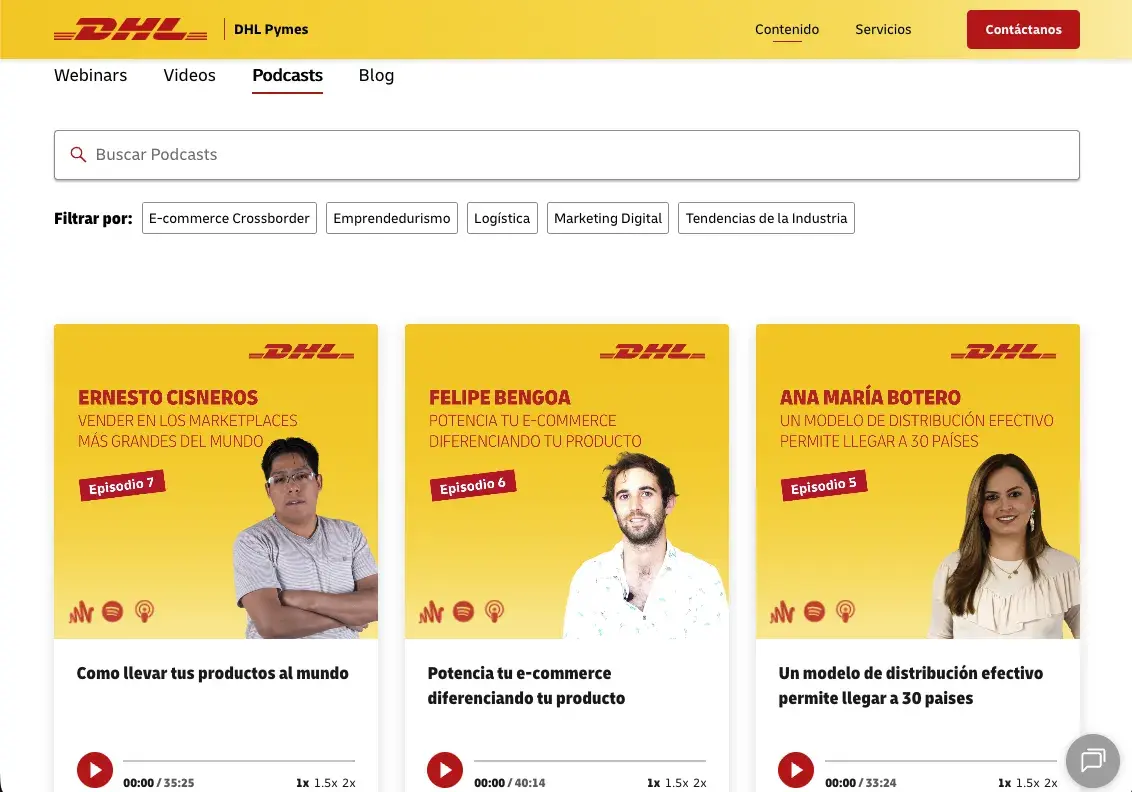
The DHL Pymes content library today — webinars, videos, podcasts and blog in one place (screenshot, 2026).
As María José Ricaurte, Head of Marketing at DHL Express, put it: "Working with Digifianz has been an extremely rewarding experience. Besides being a highly trained team, they are a clear reflection of motivation and discipline. They became an extension of our Marketing department."
What made the difference: accountability for results, not billable hours
Plenty of agencies could have booked the webinars and sent the emails. The reason the DHL Bootcamp compounded — instead of stalling after the first few events — comes down to how Digifianz works. Traditional agencies spread junior staff thinly across dozens of accounts, bill for hours logged, and hand back isolated tasks. That model breaks exactly when a programme gets complex, which is precisely when DHL needed it to hold.
Digifianz flips that. Our consultants run a small number of accounts, go deep on each client's business, and tie their own incentives to results — so the team optimising DHL's campaigns cared about DHL’s numbers as if they were their own. Combined with one unified HubSpot portal, that accountability is what turned 17 separate country launches into a single, improving system rather than 17 fires to fight.
Why does this matter for logistics and B2B companies?
Logistics, manufacturing and other complex B2B businesses usually run marketing, sales and service across disconnected tools — which is exactly why reporting is untrustworthy and leads slip through the cracks. The DHL Bootcamp shows the alternative: when a logistics brand centralises everything in HubSpot, a single campaign can educate a market, fill a pipeline and prove its own ROI. That's the model Digifianz builds for HubSpot for logistics and 3PL companies — and it's the same engine, whatever your industry.
We won't promise you 200% growth in a month. What DHL's programme proves is more durable: with the right system and a partner accountable for the outcome, a well-run HubSpot portal compounds — every webinar, article and workflow keeps working long after it goes live.
Frequently asked questions
What was the DHL LATAM Bootcamp?
The DHL LATAM Bootcamp was an inbound training programme run by DHL Express to help small and medium exporters across Latin America grow internationally. Digifianz built and operated it on HubSpot, reaching 17 countries with webinars, content and nurture campaigns that generated leads for DHL.
Which HubSpot Hubs did the project use?
The programme ran on HubSpot CMS Hub (microsite and blog), Marketing Hub (email, automation, ads, forms), and the CRM (contact management and lead routing), unified in one portal with 7 reporting dashboards. Consolidating into one platform replaced the usual patchwork of disconnected tools.
What results did Digifianz achieve for DHL?
Monthly form submissions rose from roughly 150–200 to over 2,000, webinars attracted 2,000–7,000 registrations each, and the CRM grew past 25,000 segmented contacts. The website drew 145,145+ visits and email reached a 20.67% open rate across 689,547 sends.
How long did it take to see results?
The bootcamp launched in Argentina in 2020 and expanded to 16 more countries in 2021 as results compounded. Rather than a one-off spike, the HubSpot-based model produced sustained, month-over-month growth in registrations and leads as Digifianz optimised each campaign.
Can this model work for other B2B or logistics companies?
Yes. The core play — consolidate marketing, sales and service into one HubSpot portal and run it with a partner accountable for the outcome — applies to any B2B company with complex, multi-channel demand generation. Digifianz tailors it by industry, from logistics and manufacturing to SaaS and professional services.
Ready to turn HubSpot into your growth engine?
Digifianz implements and runs HubSpot end-to-end for B2B and logistics teams across LatAm — like we did for DHL. Let's scope what a focused implementation would look like for you, starting with what a HubSpot implementation costs and why.
Sources: DHL corporate profile, HubSpot platform, and Digifianz DHL LATAM Bootcamp programme reporting (2020–2022).
Sebastián González
Digifianz, HubSpot Elite Partner
Sebastián González is part of the team at Digifianz, a HubSpot Elite Partner helping B2B and logistics companies across Latin America grow with HubSpot.
.svg)
/Vector%20(28).svg)
/Vector%20(27).svg)
/Vector%20(26).svg)


