
/Vector%20(6).svg) Back to Blog
Back to Blog
Copywriting is a crucial element of any marketing strategy, and choosing the right approach can make a significant difference in your results. As the world becomes more digital, the use of AI-powered copywriting tools has become increasingly popular. However, the question remains: can AI truly replace human copywriters? In this blog post, we'll explore the advantages and limitations of creating copy with AI versus human copywriters and highlight two of the most popular AI tools on the market.
Why AI is Changing the Copywriting Game
Artificial Intelligence (AI) offers numerous advantages for copywriting, making it a valuable tool for businesses and marketers alike:
- Speed:
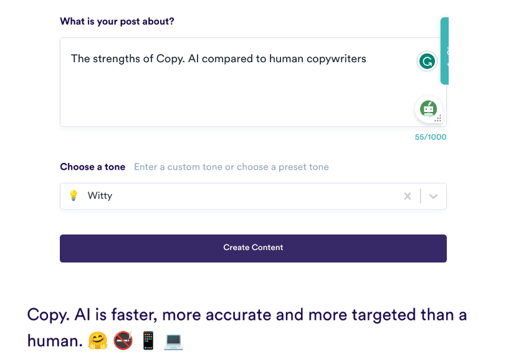
AI can create copy quickly, even in minutes, depending on the length and complexity of the text. For instance, Copy.ai uses machine learning algorithms to generate text based on user inputs. It allows users to create various types of content, such as ads, blog posts, social media posts, and more, by simply inputting a few details about their desired content.
- Consistency:
AI can ensure consistency in tone, style, and language across different pieces of content. This is because AI-powered tools use the same algorithms and data sets to generate content consistently. This is especially important for companies that produce large volumes of content and need to maintain a consistent brand voice. - Cost-Effectiveness:
AI can be cost-effective, especially when creating large volumes of content. Compared to hiring human copywriters, using AI-powered tools can be more economical in the long run. There are many tools on the market that offer a variety of pricing plans to suit different needs and budgets, like Copy.ai and Writesonic. - Efficiency:
AI can work 24/7 without getting tired, making it ideal for generating large amounts of content in a short time. This can be especially useful for time-sensitive projects that require quick turnarounds. For example, an AI-powered copywriting tool like Writesonic can generate high-quality copy in minutes, saving you time and effort. And these tools don’t get writer’s block! - Personalization:
AI can use data to personalize content for specific audiences. For example, an AI-powered email marketing tool like Phrasee can analyze data from your email campaigns to generate subject lines and email copy that resonate with your audience. This level of personalization can improve engagement and increase conversions.
The Human Touch: Benefits of Choosing a Human Copywriter
While AI tools have their benefits, there are also advantages to hiring a human copywriter for your content needs:
- Creativity:
Human copywriters can bring unique ideas and creative perspectives to their writing. They can think outside the box and come up with original concepts that AI may not be able to generate. For example, a human copywriter can use humor or storytelling techniques to make a piece of content more engaging and memorable. - Emotional Intelligence:
Human copywriters can understand the emotional needs and wants of the target audience and craft copy that resonates with them. They can use empathy and emotional intelligence to create copy that connects with readers on a deeper level. This is especially important for brands that want to build long-term relationships with their customers.
- Adaptability:
Human copywriters can adjust their writing to suit the specific needs of different brands and industries. They can research and understand the nuances of different industries and create copy that fits the tone and style of a particular brand. This level of adaptability can be challenging for AI-powered tools to replicate. - Quality:
Human copywriters can produce high-quality copy that is engaging, persuasive, and error-free. While AI can make mistakes and not know it, and humans can make errors too, human copywriters are often able to catch and correct errors and typos that may slip past an AI tool. Additionally, human copywriters can create copy that is more polished and professional-looking, which can enhance the credibility of a brand. - Human Touch:
Human copywriters can inject a human touch into their writing, making it more relatable and authentic. They can create content that sounds like it was written by a real person, which can help build trust and credibility with the audience. Furthermore, human copywriters can engage in a collaborative process with clients, allowing for greater communication and feedback. This can result in a final product that meets the exact specifications and goals of the client.
Top AI Tools for Copywriting: A Comparison of Copy.ai and Chat GPT
Copy.ai is an AI-powered copywriting tool that uses GPT-3 technology to help businesses create high-quality content at scale. The tool can generate content for a variety of formats, including social media posts, blog articles, and product descriptions. With Copy.ai, users only need to provide the main title and keywords to get new, custom-written content.
Chat GPT is an advanced artificial intelligence language model developed by OpenAI. It is based on the GPT-3.5 architecture, making it one of the most powerful and sophisticated language models available today. Chat GPT can be used for a variety of language-related tasks, including copywriting. It has the ability to generate highly sophisticated and creative language, making it an excellent tool for crafting engaging and effective copy. With its advanced natural language processing capabilities, Chat GPT can understand context and generate highly personalized and targeted content.
Is Copy.ai useful to create copy that can be optimized for search engines and social media?
Businesses can create content that is tailored to their specific brand voice and marketing goals by using Copy.ai's advanced algorithms. “AI marketing tools like writing assistants help you quickly generate original, search-optimized content for your blog.” The AI allows them to create engaging and effective content in less time. Here are some ways you can use the AI for SEO optimization:
- Keyword suggestions: Copy.ai has a feature where you can input a keyword and it will generate a list of related keywords to use in your copy. Using relevant keywords in your copy can help improve your search engine optimization (SEO) and make your content more discoverable.
- Headline analyzer: you can analyze your headline to see how it stacks up in terms of SEO and social media engagement. It gives you a score and provides suggestions for how to improve your headline.
- Social media templates: Copy.ai has templates specifically designed for social media posts, including Facebook ads, Instagram captions, and tweets. These templates are optimized for engagement and include relevant hashtags and calls-to-action.
- Tone and style options: Copy.ai allows you to choose the tone and style of your copy, which can help ensure that it resonates with your target audience and is optimized for the platform you're publishing on. For example, you can choose a more casual tone for social media posts or a more formal tone for blog posts.
- A/B testing: Copy.ai can generate multiple versions of your copy, which you can use to test which version performs best in terms of SEO and social media engagement. This can help you refine your copy and improve its performance over time.
By reducing the time and effort required for content creation, businesses can focus on other important aspects of their marketing strategy, such as developing new campaigns, analyzing data, and improving customer engagement. That said, none of these features provided by the AI can be fully trusted to give impeccable results. You will need a human supervisor to read and analyze which results work best for the company’s goals.
Is Copy.ai better than Chat GPT?
Many of the advantages of using AI tools can be found on these two platforms. However, Chat GPT can provide a wider range of use cases beyond copywriting, such as chatbots and language translation. Copy.ai is a quick and easy tool for generating simple content, while Chat GPT can provide more complex and sophisticated language. However, both tools have their limitations, such as the need for editing and refining and the potential for unreliable output. In order to compare the extent of their use we will focus on their limitations:
| Copy.ai | Chat GPT |
| Limited customization options may not accommodate certain niche industries or styles. | Requires more specific input and may take more time and effort to use effectively |
|
Can give very specific information that is not in line with what the client wants but requires an industry expert to identify not-useful information. |
Can be more expensive and resource-intensive to implement compared to simpler tools like Copy.ai |
| May provide random results. | May not always provide reliable or accurate output. |
The choice between them ultimately depends on the specific needs and goals of a marketing campaign.
Finding the Right Balance: The Future of Copywriting with Human Copywriters and AI Tools
It's important to remember that AI and human copywriting can also complement each other. AI can be used for generating initial ideas and content, while human copywriters can provide the final touches that make the copy engaging, persuasive, and authentic.
Ultimately, the key is to find the right balance between AI and human input to create effective and compelling marketing content that resonates with the target audience. We're committed to adapting to this shift and embracing AI in our processes. Stay tuned to see how Digifianz is leveraging this technology to deliver even more value to our clients.
.svg)
/Vector%20(28).svg)

/Vector%20(27).svg)
/Vector%20(26).svg)


